1. Lifeline

Attempts to define exactly where life begins are energised by ethical and political arguments about abortion, similarly, attempts to define where life ends carry the weight of arguments about medical life-support and palliative care but in both cases these questions are underpinned by a fundamental unease - the thought that life and death have no clear division and instead form a continuum.
Why should it seem unsettling to think that our existence might be on a dimmer rather than a simple switch? Perhaps it’s because the possibility of in-between states is eerie or unnatural - the living dead and the un-dead are creatures of terror.
Recent research has recorded waves of intense neural activity in the brains of patients shortly after clinical death. This could be a source of comfort if you associate it with the transcendental experiences reported by near-death survivors, less so if your imagination tends towards the macabre. If there isn’t a line that divides life and death there certainly is one that connects them.
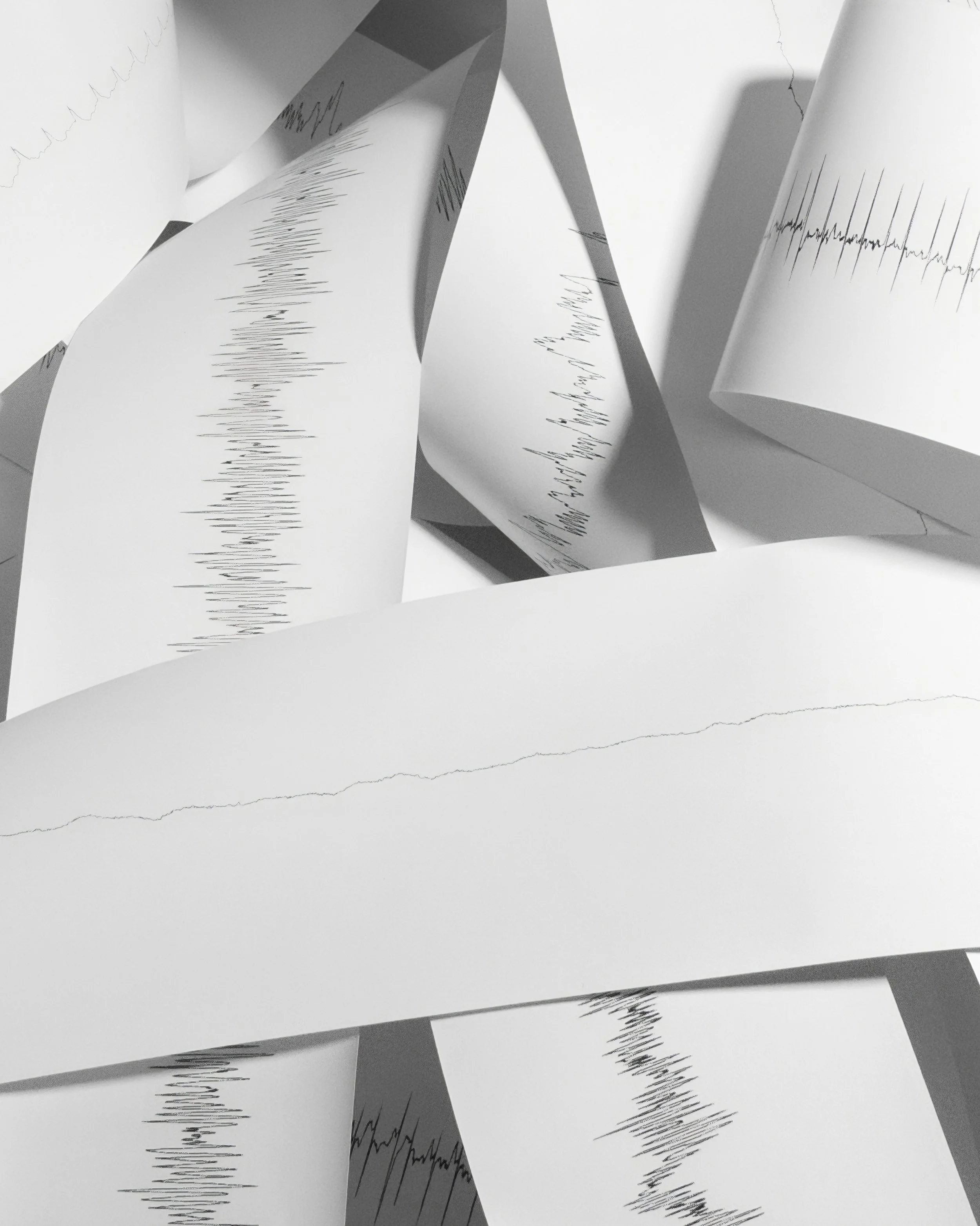
This work, Lifeline, uses ECG data from the Sudden Cardiac Death Holter Database, collected in Boston in the 1980’s. Originally compiled for an MSc thesis by Scott David Greenwald, this database became the basis for several studies looking at the mechanisms of cardiac arrest. Each ECG tells the story of the last few hours of a person’s life, simplified into a single black line. Lifeline consists of two elements:
A 2hr 44minute video showing the real time printing of the ECG record of a single, anonymous, patient from the database via an adapted point-of-sale thermal printer. The video is accompanied by audio extracted from the ECG data-file.
A photograph of the finished 45 meter printout.
NB - This is a preview of the full 2hr 44minute film which can be viewed below.

Music composed and performed by Matthew Lee Knowles